Monday, May 10, 2010

The Fourth Kind


Right off the bat, lets ascertain what a few people might be wondering about The Fourth Kind: is some of the contents rooted in any truth whatsoever? Is the viral campaign the geneses of some kind of celluloid disclosure? The answer, sadly, is no. The Fourth Kind is almost entirely fictional in every regard. The same formula applied to films like The Blair Witch Project and Paranormal Activity have also been used … albeit with an inflated budget. And the resultant outcome of all this is something more closely resembling an embellished narrative like Fire In the Sky.

When the first slivers of the viral campaign began to spill into my awareness, I will admit to a certain excitement ... because the subject matter has been close to my heart for over three decades now. In the early promos, we bore witness to things like film-footage of the Disclosure Project for the Press in 2001 (an event that was over-shadowed by subsequent world events later that year), and very high quality video recordings of vehicles in our air-space defying conventional explanation. This, however, is where the fascination came to an abrupt stop. If there existed even a smattering of truth to the project, I would have stumbled across it in my personal research. Alas, The Fourth Kind was going to be more in league with a mock-documentary. 

Said documentary centers around the citizens of Nome, a small town in Alaska experiencing an unusually high number of disappearances and visits from the FBI dating back fifty years. Dr. Abigail Tyler (Milla Jovovich) is a local psychiatrist delving into the local’s night-time world and soon discovers a great percentage of them are exhibiting the same symptoms and telling identical tales. Dr. Tyler also lost her own husband in mysterious circumstances years previous ... and is not immune to the collective phenomenon of Nome. Filmed events are spliced with so-called ‘real’ footage (annoyingly at the same time), of patients undergoing hypnosis and recalling an assault by non-human intelligences.

What director Olatunde Osunsanmi has done here is essentially create two films … both of which are false. After a while, the supposed real interviews with the authentic and skeletal Dr. Abigail degenerate into far-fetched lunacy. And any belief we might have harbored at the beginning is slowly eradicated where everything here feels more akin to something like Blair Witch 2: Book of Shadows. Olatunde uses the mythology and folk-lore of real world abductions (None's people are experiencing the screen-memory of an Owl, a common cerebral-surrogate for fourth kind encounters), but doing so in a way that is fixed and vacant. Our intruders malign aspect is layered on like an evangelicals ramblings, then ramped up to create the titular Hollywood ‘jump’ moments.

A few positives can be taken away: the washed-out and blue sepia world production design has chosen is perfect for encapsulating Alaska. Some of the director's techniques and high-camera angles show the initial stages of someone who might find a permanent home in horror. On occasion the music and flash-back sequences can be quite disconcerting. Ultimately, however, Olatunde Osunsanmi has taken a fascinating theme ripe for dissection and turned it into schlock. 

Monday, April 5, 2010

Mischief by Douglas Clegg


Clegg is another writer whom (like Jack Ketchum) has somehow managed to go under my radar over the past couple of years. Recently, however, the author's presence seems to be everywhere: social media; websites dealing exclusively in dark fiction ... and of course having his titles pop out with ever-increasing reliability in book stores and their bargain bins displayed out front. And (like Ketchum), seems to be one of those sculpting a high reputation, releasing a novel every year with timely precision and garnering distinct words of praise while doing so.   

Apparently Mischief is the first of a trilogy in the Harrow Academy series, which also features a previous e-serial prequel Nightmare House ... and the entire thing (does) read like something you must have prior knowledge of. In this regard, my ignorance was frustrating; contained within were too many mysteries that lacked revelation; too many character reactions that were perplexing. However, other's will no doubt be overly intimate with the Harrow legacy … and it seems written with these reader's in mind.

Jim Hook is on a scholarship at Harrow, a prestigious prep school located in the Hudson Valley of New York. Years before his older brother Stephen and father perished in a car accident, and the wounds are still raw. Not only was Stephen the epitome of a perfect brother everybody looked up to, he was also a catalyst for shaping Jim’s philosophy and might have secreted a small supernatural pledge into Jim’s life in the aftermath of his death. We follow Jim as he adapts to the all-boys school and are introduced to the people around him: Lark, his beau from a nearby all-Girl's school; popular Trey Fricker, his best friend. And underlying everything is an almost invisible threat, never clearly articulated. It appears when his brother Stephen died, Jim unwittingly became a channel that would potentially enable something malign to enter the world ... and when Jim gets caught for cheating, he is inadvertently thrust into the realm of the Cadaver Society, a secret fraternity who have been pulling the strings at Harrow for a long time. Facing the threat of expulsion and upcoming initiation rights, he becomes haunted by ghosts of the living and dead ... 

A favorable thing for me was the prose; Cleggs style is simplistic and easily accessible. But there are many puzzling aspects here like signposts with no clear direction: a plot-strand involving Harrow’s principal that is curtailed before it even begins; the mystery of his father and brother's death with allusions the official story involved a conspiracy. As a reader, I felt as if I had been handed a pile of jigsaw pieces, none of which seemed to belong to the same portrait. Clegg puts a ton of effort into making the climax creepy ... but (for me), the aim was too lofty, and ultimately confusion ensues. That’s not to say other reader's won’t find things to like - and I can see it appealing to those who like their horror with a smattering of the juvenile.

As a novice to Clegg’s work, I think I (may) have stumbled upon the wrong book to get the juggernaut rolling. However, Mischief will  pique your curiosity, and I have the novels You Come When I Call You and The Halloween Man with appraisals to follow. 


The Burning by Bentley Little


Like many horror writers working today, Bentley Little has crafted a style all his own own. While his books invariably follow a formula, it is a well-mapped formula, ensuring a dedicated audience and often-imitated writing method.
Little's dedication in The Burning is interesting, and gives a fascinating insight into the roots of stories and how they manifest and evolve. In this case, Bentley' son requested a story including a haunted train and two graves marked Mother and Daughter, respectively. Taper this with his method, and Little delivers a simple, elegant novel with no pretensions about its grassroots influence.
As with previous forays, our narrative is heavily influenced by a Chinese mythology. In The Burning we have Angela Ramos, an hispanic university student who has just moved away from home into a share house with a ghost. There’s Henry Cote, a Native American Park Ranger plagued by perverse, erotic dreams of Chinese twins who haunt the Canyonlands. Recently divorced Joylene has moved to Bear Flats with her son Skylar to start a new life living with mother … soon to come across the eerie graves of Mother and Daughter. So too will they witness the gaunt, leprous face that peers in at Skylar during the night, grinning malevolently. And finally a Chinese American, criss-crossing the country on a journey of self discovery, being called toward something he only partially understands; toward ancient ancestors seeking redemption for past transgressions.

At the center of this group (and slowly peeled away through their strange encounters), a hellish Train raised from the bowels of history and carrying the departed souls of different races seeks reprisal. Those that have been wronged by Caucasian man since the Civil War and beyond.


At its heart, The Burning is primarily a revenge novel, seen through the eyes of very disparate characters trying to connect the dots before the inevitable showdown as our train finally pulls into its metaphorical station. What I liked about this novel – as apposed to Bentley’s previous outings – was the more worldly aspect to it. Too often, Bentley concentrates on small-town mythos (and though this is a perfectly honorable way to tell the tale), it was utterly gratifying to see things like the White House being laid waste to eternal powers. Moreover, our trips back in time to witness heinous acts committed by those before the turn of the last century. And it does this without being too preachy or trying broadcast a message. 


There exists another horror review site that parcels out stars based on the smell of a book. A little eccentric, but one oddity I think we all can relate to. In the spirit of this, I give The Burning 5/5.

Jack Ketchum's The Girl Next Door


As a dark fiction aficionado for most of my remembered life, I am at pains to divulge the sad fact that I have never read a book by Jack Ketchum. From a distance I have followed his career on the peripheral sidelines, often frequenting his website and keeping myself up to date with his resume and celluloid adaptations. As I type these words I am at a loss as to the precise reason I have never held one of his novels in my hand. Marketing is a big factor—during a thousand entrances into a thousand bookstores his name has never popped out among the ranks of many others. Even when strolling through the horror or fantasy sections with an eye for detail has my index finger skated across his name. And there exists no rhyme or reason to not having purchased one online. Chalk it up to the same fate that has befallen authors like Graham Masterson or even some of the authors whose name appears with mine in the editors/reviewers list on this site. There exists a desire to eventually get around to them … once I have gotten through the myriad of tomes in a perpetual and never ending reading list.
Regardless of never having tackled one of his books I do know that Jack Ketchum is held in very high regard among the collective tribe. His fans include the prolific and the not-so-prolific writers, as well as commanding a dedicated and loyal fan base of readers. The Girl Next Door has been adapted from a 1989 novel of the same name and stars a bunch of relative unknowns who give charm and sophistication to this harrowing study of human innocence; an education delving into dark regions that so far have been relatively uncharted in cinema …
To call this movie ‘harrowing’ is an underestimation. And a little too simply put as it does not fall neatly into the realm of horror. We begin our journey with the introduction and narration of an adult David Moran living in the present day. Plainly, emotional demons assail David as he recounts a sequence of events from his childhood where he bore witness – and participated in – unspeakable acts against an innocent girl. Think the same formula King utilized with IT or perhaps Hearts in Atlantis. Tapping into the nostalgic era of the 1950’s to present how inarguably terrible and magical puberty can be. This, however, works - and Ketchum and the filmmakers have their fingers pressed firmly on the button of bringing this period to life: the cars, fashion, hairstyles and politics are like a metaphor for what’s really going on; that lurking beneath the veneer of plastic suburbia beats the malicious human heart only waiting to rise to the surface and take over.
A typical teenager, David is introduced to a new girl who has recently moved into the neighborhood whilst catching crawfish. Megan Loughlin and her crippled little sister have come from another town to live with their Aunt Ruth Chandler (David’s next door neighbor and an eccentric divorcee). Ruth has three sons of her own and her house is like a relaxed beacon to the neighborhood kids during the summer: beers can be drunk within; cigarettes can be smoked. However, her authority and discipline can be just as far reaching as her philanthropy. At first, her chastisement of Megan for relatively benevolent or even nonexistent crimes is subtle – this is, after all, 1958. But when her unconventional ranting on why punishments must be dealt out to Megan fan out into madness, she proceeds to take the children on an odyssey of torture and clout where adults write the rule of Law and anything they say is permissible.
There are so many ethical and emotional questions raised in this film it would be foolhardly to list them all here: discover them for yourself. Answer them for yourself. The Girl Next Door is a devastating picture you will not easily forget.

The Box


Love or hate the work of Richard Kelly, there is no denying this writer/director has had a huge impact on cinema. 2001’s Donnie Darko was the film hundreds of film geeks the world over had been clamouring for: an utterly original dark portrayal of a troubled youth (Jake Gyllenhaal) set in the eighties that is now a cult phenomenon. Although it borrowed a few motifs, nobody had quite seen anything like it before. The eccentric editing and camera angles, hallucinatory sequences, and the ability to raise more questions than provide answers all added up to an unforgettable experience that is rich enough for many repeat viewings. Kelly's follow up, Southland Tales, was an apocalyptic excursion that received less-than-stellar attention, critically and commercially, yet does have a small cadre of admirers. It is apparent that with The Box, Kelly is attempting somewhat to shift into the mainstream.   

But his definition of ‘mainstream’ is probably not what you think. Aside from having some familiar faces (Cameron Diaz, James Marsden and Frank Langella), The Box is utterly mired in weirdness. Based on Richard Matheson’s short piece Button, Button – things start off subtly then proceed to delve into that weird and wonderful Darko dominion; a complex series of intrigues like a Russian Doll piece. And this is a good thing. The Box requires your unmitigated participation and imagination. Nothing is overtly ‘done to you’. Ultimately it's up to the viewer to connect the dots and find your way to revelation.

Norma and Arthur Lewis are happily married suburbanites in 1976 with a young son. One night, they are awoken by their doorbell to find nothing but a package containing a small wooden box complete with button. Initially, the gift-bearer vanishes, and we are slowly introduced into the couple's lives. Authur works for NASA in development; Norma is a teacher with a secret. While a somewhat mundane progression, I loved this aspect of it ... because we're taking a short trip inside Richard Kelly’s skull: his own father worked for NASA, and the decade is pulled off with precision.  Houses, automobiles, and fashion; all of it enough to induce nostalgia. Of course, the mysterious stranger returns, and informs the couple that if they press the button, they will be awarded one million dollars tax-free. The price? Someone they do not know will die. Simple as that. Except its not, and the consequences are more far reaching than either of them can imagine.

There is a slight carnival feel to The Box. Like King’s Needful Things we have the dark, forbidding stranger gentlemanly in nature but not altogether human. If you’re familiar with Donnie Darko and Southland Tales, you’ll see many of the same faces from both films. Toward the end, similar effects are ratcheted up as we cross into other realms of experience. There’s a touch of humour … and the feeling of being simultaneously in suburbia yet ensconced in the otherworldly is a welcome duality. Performances are solid, especially those of Diaz and Langella. The score (composed entirely by Arcade Fire), is used to fantastic effect and becomes a pivotal part of a stunning climax.

While not containing the mythic and enduring quality of Darko, The Box is still a reputable effort in Kelly's envious oeuvre.  


Sunday, April 4, 2010

Sorority Row


You always come to these films filled with slight trepidation. On one hand the intellectual within screams that you must not enjoy this particular sub-genre. Because only dullards subscribe to campy schlock where there is more flesh on display than blood and the plot is derivative of a thousand such other outings. On the flip side, there is an inner-child that recalls those outings with such unalloyed fondness you yearn to be dazzled by the mindless spectacle again. 

During my first screening of Scream many full-moons ago, I recall nothing but unadulterated joy. A re-awakening was in the offing – horror was in the process of a reinvention and we had a shining future ahead with more its ilk to follow. And follow they did: I Know What You Did Last Summer, Urban Legend, Valentine, Final Destination and The Faculty. It kick-started mindless sequels and reinventions of past maniacs. Did I garner enjoyment from these horror/thrillers even though there was now a trite formula and almost identical looking posters?

I did.

And this is where Sorority Row fits in. The cast is young, American, and utterly beguiling. The stage is Theta Pie – a Sorority House where Jessica, Claire, Ellie, and Megan are celebrating upcoming graduation. They have a motto and are sworn to trust, in secrecy and solidarity. It opens up with a huge party: everyone drinking from the quintessential American Pie red cups that seem to be the only type of cup in a thousand college films. After discovering one of the girl’s brothers has cheated, they devise a revenge scheme in the form of a prank entailing feigning death. Not everyone is in on the joke, however, and when the prank goes horribly wrong the audience is treated to some grisly moments and surreal tension. Similarities abound with I Know What You Did Last Summer. 

In the aftermath of their friends death the remaining girl's keep their motto by swearing to never speak of it again. Of course, such a plan is doomed to failure - and the outcome warrants a trapezoidal odyssey of carnage as someone has taken to enacting revenge by picking them off one by one.

Apparently, the actors in this film are reality television stars making the leap onto the big screen. Though their previous forays are not apparent as the audience is treated to some witty dialogue and even grow to enjoy their arcs. The body count and dispatching – though not overly huge – is lent some creative drive as our over-sexed and alcohol guzzling young adults are terminated in new and interesting ways. The guessing game of who’s responsible comes into play … and is handled with intelligence.

Will Sorority Row be a mind-numbing experience worthy of repeat viewings? No. Will it become a cult-classic? Probably not. But I do recommend taking your favourite thrills partner to enjoy a film that pretends to be nothing but good entertainment. 


Deadlight by Troy Barnes


Many of you might be aware of Troy Barnes. In 2008 this native Tasmanian burst onto the scene with the self-financed debut Deadlight here under the microscope. The very next year he went on to publish MONOChromacy. Troy’s work is like holding up a mirror to some of the more archetypal horror stories of the past, while he still manages to find his own voice over the extended length of a supernatural thriller.

What has consistently drawn me to Deadlight over the past two years (and finally made me grab it), is the cover illustration. From a distance it piques the interest: a dynamic blue color scheme by graphic designer Jessica Turale acting like a beacon. After a quick perusal of the art and blurb, we have a good idea of the territory on show. 

Carter City: Detective Nathan Stone and his partner Ritchie Clements are on the trail of a female serial killer dubbed ‘The Messenger.' Over time, with no clues and no leads, the bodies begin piling up. What becomes evident is they are dealing with a young woman of no ordinary ilk. With almost uncanny super-human strength and agility, Sarah is able to fight and ‘see’ the malignancy inhabiting a human spirit - those who have committed heinous acts in the past. This gift (or curse) was bestowed upon her after awakening from a coma. Her assignment on this side of the veil is to dispatch those who dwell within the Deadlight.

There are great portions of Deadlight that deal with police mythos and work. In parts it’s gritty and stylish, reflecting a kind of washed-out noir world of chain smoking detectives. In other parts, the banter can be loose and ill-fitting. Oftentimes, authors can deploy the act of imagining with minor attention to verisimilitude. When reading, I was reminded of how Stephen King once remedied this. After completing a preliminary draft of From a Buick 8, he took it upon himself to spend some time with real-life troopers in Pennsylvania, thereby adding flavor that wasn't just guesswork and things cobbled together from reams of modern US cop shows. Of course, not everyone can have such resources at their disposal, so Troy is ultimately to be forgiven.

Things certainly crank up around page 120, as Sarah is more heavily introduced into the fray of the wicked. One of the positive things here is Troy is no slouch when it comes to bloodletting: Sarah’s lack of conscience and irrational behavior can be grating at first, but over the course of the novel we see how and why this is so. At times, her method of purging humanity’s dross happily reminded me of Jigsaw from the Saw franchise; the same ethical conundrums present themselves … and the killing methods are just as creative.

After completing the novel I was in two minds: on one hand certain errors were jarring. On the other we know we’re dealing with an author who is in the infancy of their career. Troy Barnes is talented, and you can tell he cares about what he is doing. There’s both heart and determination in Deadlight. I imagine that by the third or fourth effort, he will discover an ambitious narrative that will ultimately sell books. For this reason, Deadlight is certainly worthy of purchase.


The Birthing House


Christopher Ransom has burst from the blocks with one of the most astonishing debuts to emerge in recent years. He has created, with The Birthing House, a distinct and homely voice that will find a devoted readership. Although the story falls within a genre that is well-established, Ransom here defies tropes with the  kind of syntax only the most gifted writers can tap. 

Initially, I must admit to almost bypassing this one. Etched on the bottom is the kind of mantra one wants to avoid when purchasing a novel: If you like Stephen King, you’ll love …’ Let’s face it: nine times out of ten these would-be Steve King’s fall very short on capturing anything but a swollen and pale imitation. However, The Birthing House does not deserve this dime-store treatment. Of course, there are comparisons to other books, but the author has shoved all of these together with such disparate force The Birthing House reads like the ultimate homage … with Ransom’s unique voice shouting to be heard above the others. 

Conrad Harrison is a man that likes new beginnings, fresh starts. The decision to pack up and move to Wisconsin from California seems a natural one after the death of his father. Although never close to the old man, his inheritance gives him an opportunity to move himself, his wife Jo, and their two dogs to a 140 year old Victorian house in Black Earth.  After his wife disappears on a training program, Conrad is left behind to soak up the house's long and unique history. When the neighbors decide to hightail it for a holiday while leaving behind their pregnant daughter Nadia, the house decides more history is in the offing … this time featuring Conrad and his pregnant friend.

After much consideration, The Birthing House is the literary equivalent to Nirvana’s semaphore effort In Utero; an album whose music and artwork is themed with birth, babies, and new beginnings. Christopher Ransom’s book works in much the same way … inviting the reader to share with him an event of existence steeped in blood and mystery. It’s full of life, the prose like a professional, and certainly not a debut.

To give birth to a novel like The Birthing House, to bring it into the world all bloody and screaming, Ransom has consulted that which has come before: Bag of Bones, A Winter Haunting, The Stake, Misery and Secret Window, Secret Garden. But The Birthing House resonates with his own unique interpretation of the concept … and this is the reason for its success.

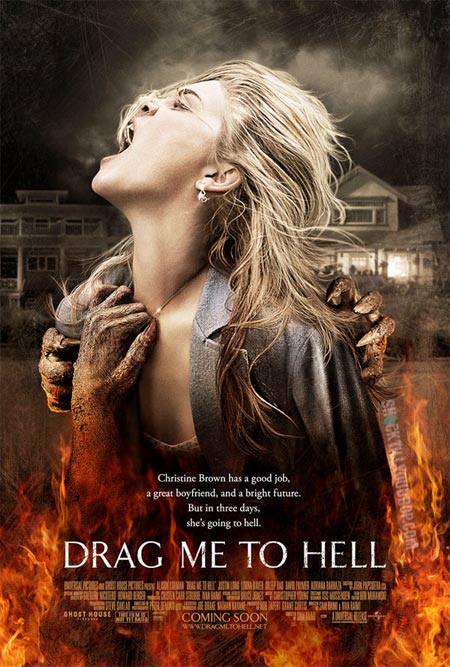
Drag Me to Hell


One of the principal horror directors of all time has taken a break from gargantuan blockbusters and returned to the genre that sparked a revolution amongst the dark faithful. The Evil Dead Films basically showcased the genesis of a new and fantastical way of low budget film-making: a trilogy sparking thousands of imitators and setting the bar for what can be achieved when natural, creative genius is given free reign. Drag Me to Hell is a fictional nod to many influences, but still stamped with Sam’s unique brand of inventive camera work and strong visual style … 

The film starts off in a mundane world all of us know to well: the office space. Christine Brown (Alison Lohman), is a loan officer in a bank and adheres to the whims of her superiors in the hopes of landing a lucrative Assistant Manager position. This is great angle; Sam and his brother Ivan have penned a realm clinical in the details; the familiarity of the nine-to-five hum drum is so part and parcel with all of us that (knowing what is to come), we feel strapped in for a joyride. We know Christine’s world is about to be shattered, her cosy niche forever transformed by what we have seen and know of the plot.

And that (the plot), concerns one Mrs. Ganush, an old gypsy who is refused an extension on her mortgage by Christine, is ultimately shamed, and seeks vengeance by cursing her in an ugly stoush that has to be seen to be believed. Sam Ramai knows what repulses us, and he uses the character Mrs. Ganush to really get under our skin in this regard. For me, there is just something so ultimately creepy about old hags … especially ones that cackle and have a vendetta or score to settle. In the aftermath of her confrontation, Christine is visibly shaken, and persuades her boyfriend Justin (Clay Dalton), to consult a fortune teller … perhaps a way to gauge whether or not the cursing of her jacket button had any real ramifications. The seer is Rahm Jas, someone who is wise in the ways of dark arts and is, in due course, recruited by Christine to help understand the enigma she is dealing with.

To go into detail regarding this enigma is probably giving too much away, but suffice to say Rami, during the course of this dark excursion, gives us everything we’ve come to expect of him. There’s the horrific moments of possession laced with delicious slapstick comedy; scenes of pure relentless terror where nothing is shown and everything is only suggested or hinted at. An apocalyptic climax with genuinely gross scenes … and of course no modern horror or thriller excursion is complete without an unexpected twist. Here, the performances are solid, and the effects are ratcheted up to very decent levels. I have a feeling Raimi would have enjoyed working with a limited budget without the mind-numbing intricacies a franchise like Spiderman would have presented. 

Throughout its duration, there was at least half a dozen times the audience visibly jumped or were rocked backwards ...

Hackles raised in a crowd is a sure sign this observer was viewing a future classic.

The Lobby by Christopher A. Durish


Walls closing in. 
Crowded blood soaked recollection ... 

This is just a small stanza of The Lobby's opening lines. It's a book that, after a brief skimming, was supposed to put be put down in favor of more pressing titles. However, what began as a mere perusal ended up being the catalyst fire for reading the entire novel ... a sure sign Christopher A. Durish knows the right hooks.   

Zachary Bell is an up and coming yuppie in the world of advertising. He's a married father of two daughters living in New York. Yet his existence resembles nothing constituting the American dream. For his nights are spent attending the sordid parties of a wealthy elite, and succumbing to infidelity. More distressing is his apathy and utter lack of conscience. So when Zach's car plunges off a cliff in the aftermath of one of his infamous parties (his mistress at his side), it is no little surprise to observe he feels no remorse for her resulting death ... 

From here, we're treated to a kind of surrealistic Hell as Zachary awakens from a brief coma. Though attempting to return to stability he's assaulted with fleeting images of the afterlife and creatures germane to that realm. This is where things crank up, as Christopher paints a mesmerizing picture of the underworld's environs and those souls who skate along the peripheral abyss. That said, The Lobby tackles a Judaeo-Christian mythology ... and those who find this belief system somewhat implausible when trying to get their chills may be disappointed. However, The Lobby's prose, like an intricate webbing of the grotesque, is maturely handled and not bogged down with dialogue. I was eerily reminded, pleasantly so, of novels like Dean Koontz's Hideaway or perhaps one of the latter (but better), Hellraiser adaptations.

At times the horror on show can be somewhat cliché in the details, and certain paragraphs will have the same word repeated multiple times (a pet hate of mine), but overall this is an excursion worth taking. Here, the domesticity of family is handled deftly, and there is an oddly comforting chaos as Zachary is propelled toward his destiny.

Without using any eloquence, I'll just say I really enjoyed this book: its pulpy, yet simultaneously sophisticated.

The Lobby
is available from Sense of Wonder Press.