Wednesday, May 8, 2013
Wednesday, April 10, 2013
Cassadaga
A 2011 movie that piqued
my curiosity for two reasons: first, the somewhat retro poster raising questions: is this a homage to eighties horror? Or do we
have something like a modern slasher in the offing? At a glance it evokes the
VHS imagery of a bygone era ... or perhaps (for some) the artwork is
reminiscent of their favorite small press horror title. Secondly, I was drawn
immediately to the director we have at the helm: Anthony DiBlasi – a name that
people with more than a passing curiosity in Clive Barker will be familiar with. Not only did Anthony direct the amiable adaptation of 2009’s Dread, he
served as an executive producer to both Book
of Blood and The Midnight Meat Train.
Personally, I would have liked to see the director continue this independent
foray into Barker’s territory. His films - although sovereign in nature
and nowhere near the mainstream -
contain a genuine feeling for Clive’s material. While commanding small
budgets (as was the case with Dread),
we still had something as slick and unnerving as anything released by a
major studio. This time around, Anthony has chosen a world more conventional
in the trappings. With an interesting script featuring a prolific spiritual
community and an Oscar winner in tow, all the ingredients were there for strong film.
Lily Morel (Kelen
Coleman) is a pre-school teacher – a gifted one, the obstacle of
being deaf failing to waylay her ambitions. Her younger sister Michelle lies at the
forefront of her world, but tragedy strikes when Michelle is killed by a motorist,
terminating the pair’s long-term plans to begin a new life in Paris. Seeking
solitude to both grieve and work on her paintings, Lily takes up residence in
Florida’s Cassadaga – a community of fringe artists and mediums. Welcomed
into this spiritualist camp by ageing guru Claire (Louise Fletcher), and a
local single father, Lily sets about teaching again. And although she begins to
forge new relationships, memories of Michelle are still sharp enough for her to
visit one of the local psychics in an attempt to placate her warring emotions
and (perhaps) make contact with her sister again. It’s a palaver ultimately leading to a group séance – one that grabs the attention of a
different entity altogether: the ghost of a murdered woman who also resided in
Cassadaga.
At times, it’s a
confusing mish-mash of genres. On one hand we have the elegant simplicity of a ghost
story – the trusted formula made famous by tales such as Matheson’s Stir of Echoes. (Whereby our protagonist
is charged with identifying a killer).
On the
other the audience is subjected to another ambiguity altogether – a serial killer at the heart of it all. Known simply as the ‘Geppetto’ killer, we are given only brief snatches of this tortuous being and his past through an incoherent series of flashbacks. Confusion aside, the Geppetto is a truly nasty creation; a monster woodcarver fashioned by a zealous mother who hacks off the limbs of females to produce personal marionettes. Assailed by visions of his crimes, Lily is aided in her sleuthing by single father Mike, a relationship that soon blossoms into romance but in the end becomes mindless filler as their tryst ends abruptly. With the climax looming - and the two becoming closer to unshrouding the mystery - the character of Mike is unceremoniously pulled ... almost as though his role were hastily written out of the screenplay. Solo, it then falls to Lily to unmask Geppetto before he begins his carvings afresh.
Despite the problems
here (and there are many of them), I couldn't forget this is an
independent film. And for such a small picture those involved have made up for
the tribulations much like they did on the director's other projects – that is,
accept the shortcomings by imbuing other areas with a professional sheen. In the case of Cassadaga,
these entail the general performances
(especially Kelen Coleman’s), and the addition of some disturbing imagery. Most notable is the
overall use of suspense. For these reasons alone, Cassadaga is more than adequate to fill a niche.
Friday, April 5, 2013
Thursday, March 21, 2013
When the Lights Went Out
I came to When the Lights Went Out with absolutely
no fixed ideas or suppositions – something rare in this age of
information saturation. With somewhat misleading posters and hooks (based on a
true story is probably one axiom in the horror climate certain to provoke distrust), I was somewhat surprised to find a domestic
ghost story that is both intriguing and
alternative: light years away from the usual forged glamour peddled out every
time a major studio attempts to translate something rooted in truth.
When the Lights Went Out
is based on The Black Monk of Pontefract (a 1974 British poltergeist haunting occurring in the home of Joe and Jean Pritchett). The real-life case in
Yorkshire – although never reaching the lofty global proportions of The Amityville Horror – was still devastating to the local community as a
whole. One of the greatest strengths of this film is a viewer’s curiosity
will be piqued enough to seek out the true story for themselves. Thankfully bereft of any found footage tropes,
the makers have still managed to craft a sobering reality reflective of
working-class life in Yorkshire during a time of industrial recession and
constant electrical blackouts.
As
a haunted house tale, the beginning is a familiar one: the Maynard's have
purchased a new suburban house in the pursuit of new beginnings. Len, Jenny,
and daughter Sally are an archetypal working class family. Hauntings begin subtly
but then quickly dovetail into abrasive acts singling out young Sally at the
center of the maelstrom. Momentarily stagnant and with no way to escape their
dilemma, Len turns to the local media in order to make some quick cash. At this juncture, other residents of the town are drawn into the family’s
plight: most notably Sally’s best friend and her high-school teacher ... a man
who then becomes charged with discovering the identity of the presence in
residence.
What
other reviewers have pointed out (and what is outwardly obvious), is there is
nothing here we haven’t seen before. Instead, it excels in other
avenues – markedly how the production has brought to life the aching
nostalgia of a certain period. Here all things seventies have been evoked with an uncanny
attention to detail: retro cars, flairs, haircuts ... even the carpets and
wallpaper. Merge all of this with the cockney accents and you have a fitting
movie even without the supernatural overtones. Although things are measured and
leisurely in this regard (the supernatural), there are just enough key moments
of genuine creepiness to make this Yorkshire ghost tale worth the telling.
When the human element of the haunting comes into play (relationships ripped
asunder because of doubt and suspicion), we see a vulnerable side of the family bordering on heartbreaking. The climax, though riddled with unnecessary
special effects, is surprisingly one of hope ... something all too rare among the
current crop of modern supernatural cinema.
All
told, this is an excursion that will not go down among the pantheon of
classics; however, I can recommend it
for the domestic component alone. Dark, diverse, and above all atypical, When the Lights Went Out is subtle
viewing for those of us exhausted by the franchise mill.
Saturday, March 16, 2013
The Collector
A script originally intended as a SAW prequel, The
Collector is undeniably a film falling into the same sub-genre as that
particular franchise. Although there are certainly elements of torture porn
here (a now much-maligned turn of phrase and one I hesitate in using), this
2009 outing raises the bar slightly higher in terms of style and keeps the
physical suffering at a level explicit enough to be subtle.
Detroit, Michigan: the
Chase family has moved into an isolated mansion far from the city. Renovations
have begun in earnest, and taking work at the property as a handyman is troubled
Arkin – an ex-con who is now walking the straight and narrow. Though loose ends
abound in life ... namely that of large sums of money owed to his ex-wife. If
payment of the debt is not made swiftly, his ex-wife’s creditors will soon inflict
pain upon the entire family ... including Arkin’s young daughter Cindy.
During the course of
his work, Arkin becomes privy to every nook and cranny of the Chase estate,
learning its stairways and floorboards intimately - including which
wall-mounted piece of art hides Michael Chase’s combination safe. With the life
of his family at stake, Arkin must make one last (final and desperate) heist to
secure freedom for his daughter.
At first everything
seems textbook for the robbery ... but it soon becomes evident another has targeted the family on this particular night. With the entire house rigged
with sophisticated booby-traps engineered for maximum suffering, our would-be
thief becomes an unwilling witness to his employer’s slow demise at the hands
of a masked psychopath. Flitting from room to room in a locked house of horrors
and trying desperately to save a family in the process, Arkin’s almost total anonymity
now becomes his only way out.
One thing I noticed
almost right off the bat: there are a lot of parallels in this narrative and Dean Koontz’s 1995 book Intensity.
Both feature an unseen hero in a game of cat and mouse with a similar
antagonist. Our ‘collector’ here is a kind of human predator mimicking the
world of arachnids by trapping humans in a literal ‘web.’ That’s not to say
there isn’t originality; for
such a small budget the overall sound and visual aesthetic is unique. Like a
dark music video, a heavy atmosphere is married with strobe sequences to create
a kind of ‘snuff’ ambience. When the action takes over, the director employs
the use of excessive slow motion that might be over the top anywhere else, but
somehow feels right at home here. We have the distinct impression this is a film that takes itself seriously. Suspension of belief is required, but it almost always is when dealing with a new threat
in the genre.
Although we do not have
a lofty horror icon in the offing, there are just enough small highlights
to guarantee an extended franchise.
Thursday, March 7, 2013
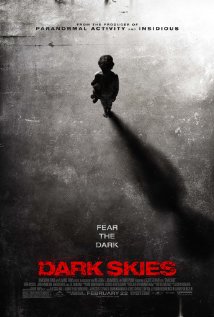
DARK SKIES
As a sub-genre of
science fiction and horror, alien abduction films will always be here to fill a
niche. Whether they are under a fictional guise (Signs) or marketed as a true story (Communion), the ever pervading fear of a genuine unknown entity
entering a domestic setting seems to be a notion as ancient as the stories
themselves. Ranging from the primeval folklore tales of succubus and incubus to
the modern phenomenon of ‘the Grays’ coming into our collective consciousness
in the latter part of the twentieth century, there is no shortage of
descriptive physical characteristics and theories as to who they are or what
motives compel them to engage with the human species. In Dark Skies, writer/director Scott Stewart takes an average American
family and subjects them to his own dark interpretation of a modern alien
encounter.
When the movie first
came to my attention, I thought it was perhaps a film version of the
eighteen-episode science fiction series that debuted in the late nineties,
riding on the coat-tails of a certain successful show called The X-Files. Thankfully, this wasn’t the
case – and a quick perusal of the director’s previous forays into cinema
revealed someone who (although achieving questionable results in the past with Legion), was looking to be setting up
shop in the horror genre, but had yet to hit his stride or find quite the right
project to call home. However, despite a few problems - mainly due to the
unoriginality of the story – it seems Dark
Skies as a working whole will win some critics over and give the director just the kind of clout he needs to branch out in future endeavors.
The Barnett family are
white, middle-class suburbanites. Their existence is mundane if relatively
happy. Lacy (Keri Russell) works as real estate agent and although an
unemployed architect her husband (Daniel) is optimistic about his future. Their
two sons, Jessie and Sammy, communicate at night through a set of
walkie-talkies in separate bedrooms. Soon, the family experiences some common
tropes of poltergeist activity: fridges are raided, furniture is rearranged,
and in one instance the entire mosaic of their photo collection is filched with
the frames entirely intact. The authorities are sought, but with no hard
evidence, Daniel takes matters into his own hands by putting the house under
surveillance with security cameras. When the terrors escalate into missing
time, implants, and the manifestations of otherworldly creatures on camera, it
soon becomes apparent the events are merely a precursor to a countdown or
‘final moment’ of unknown agenda.
It all sounds a tad
formulaic, doesn’t it? And (at least on paper), I’d agree. However, there is a
simple ambiance in Dark Skies that
works. The soundtrack is used sparingly and sometimes not at all; silence
itself becomes a sound. When each member of the family experiences dangerous
fugue states, all actors (including the children) give credible performances
that give the whole outing a genuine feeling of unease.
Lastly, it should be
noted there are more than a few similarities between this movie and M. Night
Shyamalan’s Signs. Whereas one dealt
with the alien abduction phenomenon in a rural setting, this one transports us
to an urban environment - and ultimately we have the same mixed results. If
anything, Scott Stewart proves he has learned one important lesson from the
successful director who tackled the subject matter before him: that in any
suspense film, no matter the size of your budget, the biggest scares always come
from what is suggested ... and not from what is shown.
Monday, February 11, 2013
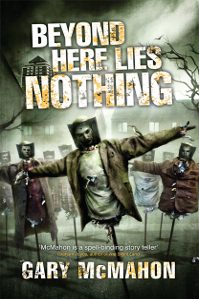
Beyond Here Lies Nothing by Gary McMahon
A few years ago, Gary McMahon mesmerized readers with an apocalyptic vision of an urban nightmare. The Concrete Grove (with its stand out artwork by Vincent Chong) came at a restless time when the real world seemed to hold up a sobering mirror to our own dark insecurities: not only in the author's native England, but for the collective world as a whole. With poverty, crime, and the decaying municipal jungle of The Grove as a playground, The Concrete Grove tapped into some of the things that truly scare us in the modern age. While the supernatural trappings were original (sinister hummingbirds are no trope), they seemed more of side dish to the main course: a human prison in the guise of a derelict suburb. Its sequel, Silent Voices, continued the tale in a more domesticated framework. With Beyond Here Lies Nothing, the author serves symmetry by taking his last book of the trilogy to the same lofty heights we experienced in The Concrete Grove.
This outing concerns another new character, Marc Price. Price comes back to The Grove to research a book about the ‘Northumberland Poltergeist' - an infamous case from the 1970s: twins haunted by the spirit Captain Clickety. Soon a relationship is underway with a local woman, the mother of one of the Gone Away Girls (children abducted years previous with no evidence of how they disappeared). That bygone case has also left an indelible mark on local cop Royle, a hardened man with an addiction to alcohol who seems to embody the Grove itself.
Not far from The Needle, scarecrows appear, their heads plastered in photographs of the missing and the dead ...
In this, the culmination of a story arc, Gary McMahon accomplishes what he set out to do: unsettle the reader not with supernatural overtures but with a desperate and broken people. If The Concrete Grove were a musical project, Beyond Here Lies Nothing would be its greatest hits compilation; a symphony of the damned returning to the Needle with unfinished business or an ultimate score to settle. Though scarred, they are well-rounded off-shoots, each player a component of the author's own black-garlanded psyche.
There were times here when I felt genuinely unnerved (rare for someone schooled in the genre). Dark and poetic, Gary is tapping into his own staple brand: a twisted school of thought we have only just glimpsed the surface of.
Sunday, January 13, 2013
The Collector by Daniel I Russell
In the craft of writing, there are many things to
love. One of them is that no matter when a story is composed during a writers
career, it can always be taken from the fabled trunk, dusted off, and – with
some diligent hard work - brought back into the present for a new audience.
After carving out an enviable swath of horrific tales over the past few years,
Daniel I. Russell has no doubt piqued more than enough interest over this time
period for people to take notice – to wonder (perhaps in their own private
musings), what other stories the author may have squirreled away. The Collector
- Daniel’s second book – is one such tale ... a story Dark Continents have
taken an interest in and (wisely) decided to give life to beyond the fabled
trunk.
Penny Crescent has its share of flawed characters. There is the Harper house, home to Frank, his wife, and their two young children. With an unhealthy coffee addiction and a predilection for violence, Frank’s seething temper almost results in unemployment from his current position as a physics teacher. Across the road lives elderly Eleanor, a student of the occult. Her grandson Joe does not like her isolation, nor the street itself. But when he arrives in Penny Crescent on a mission of rescue, he soon finds leaving will not be an option for either of them.
And neither will it be an option for the malcontent Dean twins or their helpless mother. Reckless, the boys have made their shared cul-de-sac a personal playground, with no one immune from their criminal tirades or ruffian antics.
Not even Penny Crescents new arrival, The Collector.
He comes furtively at first, a tall stranger in a
bowler hat. With red hair, a clipped accent, and the ability to read minds –
The Collector soon gives up all pretence of kindly old scholar. The residents
of Penny Crescent – ignorant of another world that lies just adjacent to them -
have something he wants. And with a supernatural army at his disposal, the new
stranger goes about the cat-and-mouse task of securing it.
The character of The Collector is by no means new. Down the corridors of speculative fiction we can see him manifest over the decades: Mr Dark from Something Wicked This Way Comes springs to mind ... also Leland Gaunt from Needful Things and Andre Linoge from Storm of the Century. Ancient, otherworldly – and with just the slightest trace of humour, they are the antagonists who passively sit in the background whilst Hell’s minions run rampant at their command. That isn't to say we don’t still find them endearing – we do. And Daniel makes sure this particular one has just the right balance of sophistication and malign intent.
With any novel this big, there will be drawbacks. And with The Collector I found it was something I hinted at earlier: time. Being only the author’s second book we can see a distinct flavour of simple, almost juvenile monsters running throughout the chapters. The story itself is like a bridge in Daniel’s reading habits; an amalgamation of Richard Laymon and Clive Barker, respectively. As a whole this can be sometimes be grating - because the styles do not suite as a working duality within the same book.
But there are also many strengths ... and that’s Daniel's trusted ability to simply to entertain. The dialogue is realistic, and the characters are abhorrent and likeable enough in equal measure. If I could compare this to another work that has a similar framework it would be The Regulators by Richard Bachman. In that book, worlds collide and the horrors of suburbia are made manifest through the dreams of very ordinary people. Here Daniel I. Russell is working a very similar motif, but in his own distinctive voice. With a sequel on the way, The Collector is a tale that will only get better.
Saturday, December 22, 2012
The Next Big Thing
A series of questions that has been doing the rounds lately:
What
is the working title of your next book?
The working title, and the one that I imagine will
stick, is called DAVEY RIBBON.
Where
did the idea of the book come from?
Years ago (I think this may have been as far back as
2006), my younger brother and I decided on a brainstorming session for a collaborative
effort of dark fiction. We are both cut from similar creative cloth (he a
talented illustrator), with myself applying a life-long fixation with the
horror genre into the Australian horror community by writing for HorrorScope. It
was a session that didn't last long ... but he provided me with a few
illustrations that would eventually germinate into what would become DAVEY
RIBBON. Mainly, this was my ambitious attempt to pay homage to the stories I
grew up with featuring small town mythos. I had already pursued the world-building path with the broader arc of a story called OLEARIA. Now it was time
to scale down the canvas - to use a modern American town and its populace as a cauldron on the cusp of Hell. The trick here was sculpting a worthy antagonist - creating a fiend that was almost child-like in its sense of manipulating human beings.
What
genre does your book fall under?
I think the story is probably too subtle for HORROR.
Let’s just stick with dark fiction.
What
actors would you choose to play the part in a movie rendition?
I wouldn’t want to give away the title character with an image...
or any others for that matter. The beauty of the written word is that it
creates a lens that is entirely at the discretion of the reader. If you had
gone to see The Shining before actually reading the book, chances are you would
see nobody else but Jack Nicholson’s face strutting around on those pages. For me,
that’s utterly limiting.
That said, I could easily imagine Timothy Hutton
playing Sean Hunt - and perhaps a younger Max Von Sydow playing Norman Perks. If she was
at all interested I’d let Amy Lee of Evanescence play Samara Reagan.
What
is the one sentence synopsis of your book?
The story of Davey Ribbon was told in reverential
whispers.
Will
your book be self-published or represented by an agency?
Although I’m a big advocate for self publishing, I
think this one deserves to have a broader audience. So with that in mind I’ll
be seeking a traditional publisher.
How
long did it take you to write the first draft of the manuscript?
Although the story isn’t overly ambitious this was
years in the making because I kept putting it aside for months at a time. It
was only on the advice of someone very dear to me that I decided to go ahead
and finish the story.
What
other books would you compare this to with stories in your genre?
The initial seeds were probably planted with King’s Needful Things. But after that it has
kind of morphed into more of a ghost story along the lines of the movie Darkness Falls.
Who
or what inspired you to write this book?
No one thing, really. Just that it was time to try
and dig something big out of the sand.
What
else about the book might pique a reader’s interest?
For those people who have read and enjoyed my
shorter works, this is Matthew Tait shifting gears and moving up a notch.
Although a lot of the story here can be classified as homage, there is also a
lot of recognizable heart from my own life - something that I try to instil
in everything I write. It’s the old adage of simple revenge – but it also how
myths and legends are told through reverential whispers ... and how they are
manipulated over time to be given a form of life itself.
And one last thing ... if it had a soundtrack it
would be something composed by Christopher Young.
Passing the baton onto Troy Barnes, Paul Mannering and Brad Hodges.
Friday, November 30, 2012
Silent Voices by Gary McMahon
Returning to the realm previously envisioned in
The Concrete Grove, UK author Gary McMahon creates, via Silent Voices, the second part of a now-trilogy.
Although there are off-shoots of the previous tale here, this is a different kind
of beast altogether. Whereas the first invited us into the bleak atmosphere of
The Grove itself (like a hummingbird’s view of it), Silent Voices is more a character study of three individuals (Simon,
Marty, and Brendan) who battled its demons as children and - years later and
now grown into adulthood – return to the Grove for a final revelation,
closure, or both.
The
Good:
Steeping back into Gary’s narration is akin to a
homecoming. The syntax – while a little less cerebral this time around – moves
around the page like dark poetry. There is also an every-man eloquence to the
mood: these are hard character's chiseled from austere upbringings:
Simon Ridley is a successful entrepreneur, the only one to escape the Grove,
but a man unhinged all the same. His friend Brendan suffers the same insecurities
we all reach upon seceding into adulthood: keeping up a pretense of happiness
when the dream machine of our youth has an ‘out of order’ sign attached.
And Marty has all the hallmarks of what a neglected childhood can sometimes usher in: masochism and brutality to hide what lurks beneath. When the three reconcile to talk about a weekend in the Needle twenty years previous
they cannot recall, the resultant outcome is a commanding story of sin and
salvation.
The
Drawbacks:
The second outing of a trilogy is never an easy one;
the story usually a bridge to a final farewell that can be wobbly at the
best of times. Somewhat formulaic, Gary has chosen the trope: best friends who battled an evil in
childhood are summoned as adults to confront the monster again. For me,
this is somewhat well-worn, and probably peaked during the eighties. There is a
lot of story here where simply nothing happens, where plot-devices are pushed
aside to make way for a character to brood inwardly and stare out of windows in
drab reflection. The climax, when it comes, strives for the cinematic ... but
with only one small flashback scene it can sometimes
be hard to grasp the nostalgia and (horror movie) feel our author is trying
to illicit.
Positives (and drawbacks) aside, this is still an
accomplished work of dark fiction. It may not be McMahon firing on every
cylinder, but even the author’s bridgework is head and shoulders above many others working in the same arena. The foundations of story have been set; the cement
of the project has dried. The only thing left to do now is take one final journey back into the Concrete Grove ... and see what lies beyond it.
Subscribe to:
Posts (Atom)


.jpg)