Saturday, December 28, 2013

Tucker's Grove by Kevin J Anderson


Over the years, much has been written about Kevin J Anderson. Although the name at present doesn't appear under the word ‘Prolific’ in any dictionary, I’m almost positive it does in some alternate universe. Or perhaps ‘workhorse’ is the more apt description we are looking for here. Whereas some writer’s are content to publish a novel a year, Kevin has adopted a more streamlined approach of releasing multiple books over every twelve month cycle - each of them inhabiting different mythologies and platforms over a wide spectrum of genres. Part of this can be attributed to his eccentric yet genius ability to dictate stories while hiking in mountainous terrain (It obviously makes for exceptional productivity). While another facet is sheer hard work ... not simply composing the books, but infiltrating every aspect of the industry: attending conventions, singing books, meeting fans, tutoring the up-and-coming, collaborating, editing anthologies, giving out blurbs, hosting awards, sitting on panels, joining advisory councils ... and this isn’t all of it. To say he deserves success is an understatement. Though he may have a history of inhabiting already established realms (Star Wars and Dune), I can attest the author's own mythologies are every bit as sprawling as those he uses as a playground.

First released in 2012 as an eBook, Tucker’s Grove chronicles a group of interlocking stories centralized around the dark Midwestern town of Tucker’s Grove. Though sometimes the connection is haphazard, there is still enough cohesion overall to give the mythology a sense of continuity.

Bringing the Family

Set in the days before Tucker’s Grove is fully established, Bringing the Family records the journey of Mr. Deakin and Clancy Tucker. After a tornado devastates his land, Mr. Deakin cannot refuse the work offered his way ... helping one Clancy Tucker escort his deceased parents by horse and cart across endless prairies in order to fulfill a promise. The only catch: a ritual of digging up the coffins each night and reburying them on a slow journey to Wisconsin. A bizarre obligation, but one he doesn’t question ... until the night Clancy passes out from whiskey and the sacrament isn’t performed. A tale that lays the ground work, Bringing the Family is a short, somewhat satirical stab giving rise to zombies in a frontier setting.

Church Services

More in line with the dark fiction promised, Church Services gives us the story of Jerome Tucker - a preacher and carnival-tent exorcist in Wisconsin’s still uncharted lands. In possession of an ancient urn or, more specifically, a demon jar capable of imprisoning spirits freshly expelled from human hosts, Jerome never thinks he might be feeding the demons by containing them. Here, we have another tale acting as fertilizer for the foundation of Tucker’s Grove, nourishing the soil with corruption for the generations to come.

Last Stand 

A snapshot of the American Indian War takes center stage in Last Stand. Beleaguered and outnumbered by a tribe of Sioux Indians, a cut-off group of soldiers must resort to a depraved act for survival setting off a chain reaction rooted in magic and myth. What I liked here was the unorthodox approach, interspersing the regular syntax of story with the journals and testimony of dead men.

Scarecrow Season  

And now we come to present day Tucker’s Grove ... and a dying man impaled like a scarecrow on Elspeth’s Sandsbury’s farm. After discovering an alter devoted to dark gods, Elspeth sets about ensuring her crop yield is perpetually bountiful by making the obligatory blood sacrifices. Only her rituals aren’t quite what the Old Ones desire, and it will take a wayward traveler to educate her on the true meaning of what appeases them. More reminiscent of traditional horror in the market today, Church Services takes the familiar, the ordinary – and paints it black.

Though not every story presented in Tucker’s Grove is presented here, there are just enough slices to give one a signpost of what to expect. As someone who grew up in small-town Wisconsin, Mr. Anderson is tapping into a kind of homage ... paying respect to those stories that kept him awake (and sane), during a childhood halfway between Norman Rockwell and Norman Bates. While some of the prose can be simple (and the stories themselves more at home between the pages of bygone pulp), we still get a seldom-seen glimpse of someone honing their skills, chipping away at the bedrock, and mastering a talent which would eventually give rise to one of the most creative authors working today. 


Sunday, November 17, 2013

SLEEPER (S) by PAUL KANE


Paul Kane is a British author who has - by slow degrees - come to my attention through social media. Although not privy to reading his fiction before, I was aware had Paul entered the fray with numerous publications orbiting the Hellraiser mythos – in particular the well-received Hellbound Hearts anthology released in 2009 (of which Paul was the creative and driving force). Not only prolific in publishing circles, he seems to be an overall advocate for British horror across the globe. With Sleeper(s), Paul teams up with the burgeoning South African small press Crystal Lake Publishing to give us a short, cinematic novel heavily influenced by the epidemic sub-genre whose peak came with techno-thrillers such as The Andromeda Strain.      

Middletown UK, and an entire populace has been rendered unconscious by an enigmatic ‘sleeping’ disease that’s reminiscent of a plague. Consequently quarantined in the aftermath, the military enlists the help of Dr. Andrew Strauss ... an eccentric insomniac and a pioneer in the study of infectious diseases. Now a freelance maverick, Andrew travels the world with a (doting) assistant ready to tackle the next contagion. Though separated by a recent romantic tryst, both he and his partner are recalled as cavalry to the ghost town of Middletown, there to confront a virus appearing almost supernatural in origin. Accompanying the scientists are a motley crew of British and US soldiers – both of whom serve under different motives and clash in a melee of culture and warring personalities.

Sleeper (s) strengths:

Paul has created an ominous world around Middletown. Choosing what is almost a ‘slant’ on the saturated zombie genre – much as King did with Cell - the infected humanity here are refreshing and unpredictable creatures. Dormant to the environment and cocooned in a kind of white webbing secreted from their bodies, each ‘Sleeper’ appears to share a collective hive mind on a dreaming frequency that can also be accessed by the living. Shuffling around with malevolent intent, there is an old school flavor to these living dead hearkening back to tales prevalent in the past where characters and their motivations come in black and white ... and the view through one’s imagination contains the same tone and imagery.

Sleeper (s) drawbacks:

However, part of the problem of drawing upon a bygone era is simply having a landscape that is overly familiar. Earlier, I sighted The Andromeda Strain as an obvious inspiration ... but a reader here will also see shades of several X Files episodes and plot devices lifted directly from movies such as Inception and Outbreak. Although one could argue Kane has delved into this territory as a kind of homage to those genre tales, the characters in this book bear little relation to living persons, and have instead been lifted as cut-outs from those cinematic adaptations. There is a strong romantic element (the relationship between Strauss and his assistant), but their dialogue and private musings are rendered on the page as corny Hollywood discourse. When the climax comes – largely involving a confusing military cast – the scenes have a choppy, incoherent momentum evocative of the police-force/vigilante action sequences in Barker’s Nightbreed. (Original studio version). If I had one grievance with the overall syntax it would be a writing style impoverished by a lack of metaphor.

That said, for readers who love the cross-pollination of science fiction and horror - and like it told in a gritty action style with military nuance – there is still a lot to like here. Compact of length and cinematic in scope, Sleeper (s) contains just enough punch for a reader to seek out the further works of Paul Kane.   


Wednesday, October 30, 2013

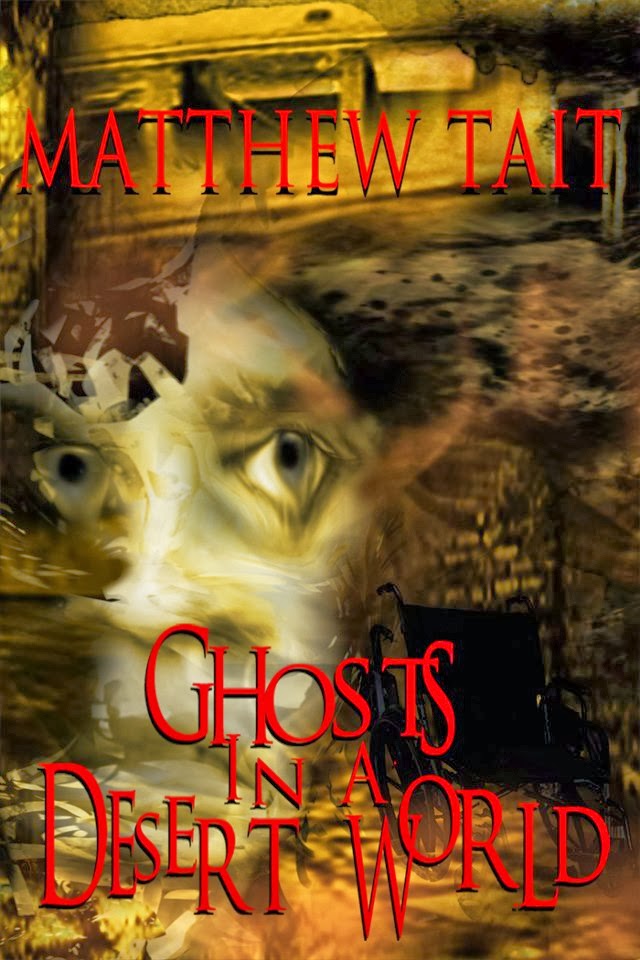
GHOSTS IN A DESERT WORLD ON SALE TODAY


As you can see from the original manuscript, this is a collection that has been whittled down over time to encompass only the best prose and stories. 


For the first time in paperback, GHOSTS IN A DESERT WORLD on sale from Amazon now. 


Monday, October 21, 2013

The Last Night of October by Greg Chapman


It’s no secret I’m a fan of what Greg Chapman is doing here in Australia. Although his written works are in a developmental stage, he has proved himself quite the renaissance man by tackling the art world with pencil and brush stroke alike ... an endeavour recently peaking with himself, Lisa Morton and Rocky Wood taking out top honours for superior achievement in a graphic-novel at this year’s Bram Stoker Awards. More than his list of accomplishments, however, is an individual who genuinely cares about his chosen fields. Earlier this year, Bad Moon Books saw fit to acquire his Halloween novella The Last Night of October. Featuring illustrations by the author himself, this is the sort of quick, deep and biting novella we’ve come to expect from Greg.  

Confined to a wheelchair, Gerald Forsyth is ill of health and in the twilight of his life. He has many concerns ... but chief among them is Halloween night. What he fears the most is not the exuberance of the annual holiday from a crotchety old man’s point of view. No, Gerald’s phobia is rooted in supernatural dread – for Halloween is the one evening of the year when a very special trick-or-treater comes knocking at his door  ... a boy from his childhood past who wants something from Gerald; perhaps atonement for past transgressions, perhaps his very soul. When a relief nurse of Gerald’s accidentally lets the boy inside, the two of them hide within the house. And it’s here that Gerald must recount his story, not only to be relieved of the burden of his guilt but of the very tale itself.  

The premise is a simple one – reminiscent perhaps of Greg’s earlier novella The Noctuary. In that particular story, similar motifs were on display: childhood secrets, sins of the past, and present day retribution. Here, however, they have been infused with the glamour and cavalcade feel of Halloween. In regards to this, Greg’s descriptions have already earned approval from American audiences (it’s common knowledge Halloween is not overly celebrated on Australian shores). The carnival feel is present and so is the nostalgia inherent in a young boy’s life – that time of adolescence when ones imagination is never riper and monsters take centre stage with love. As Gerald recounts his tale, a different sort of monster eventually steals the limelight, giving the author a chance to add even greater depth by treading the path of life’s choices and their consequences.  

However, this is not a work without some minor errors, and a reader may feel themselves taken aback when a phrase or word is sometimes repeated within a page or paragraph. An example of a sentence that could be easily adjusted:

His chest rattled and Gerald felt blockage within his chest.   

Though somewhat of a pet-peeve, I’ve always found repeated words to be a hindrance to coherent flow, giving the reader a self-conscious awareness. There is also a generous heaping of adverbs on display ... although the jury is still out with regards to their legitimacy overall in popular fiction. 

Small mishaps aside, this genuinely is a delightful book – one for all ages. Rich in metaphorical writing with an aside of aching nostalgia, The Last Night of October is Greg Chapman right at home and in his element.

Saturday, October 19, 2013

809 Jacob Street by Marty Young


In this particular stanza of a review, I will usually give a mini-lecture about the author under our microscope: how she or he fits into the landscape of dark fiction etc.etc. For Australian Marty Young, I won’t go into too much detail – but suffice to say we have an author who has been at the forefront of Australian horror for quite some time ... and I don’t mean publishing (although he has been partaking of that also). No, Marty’s time has been devoted to the shadows; working tirelessly behind the scenes to build a community that was somewhat non-existent in its current incarnation less than a decade ago. By giving genesis to a small cabal that would ultimately become the Australian Horror Writers Association, Marty changed the landscape of Australian horror in perpetuity - providing starved writers here a much-needed voice on the world stage. And he did this, of course, while tinkering away on his own novels. When the small press Black Beacon Books sprang up a short time ago, it seemed like the perfect time for Marty to release his debut novel ... pairing him with a publisher well-versed fiction and equally enthusiastic about the genre. 

809 Jacob Street introduces us to Joey Blue, a resident vagrant of Parkton. (Think Castle Rock or any other fictitious town). Joey is an old bluesman who wanders the borderlands of his town, never quite figuring out if he is actually alive or a ghost himself. Blotting out the past with heavy drink, Joey is paid a visit from an old friend who requires help - whose disappearance years ago is tied to the house on 809 Jacob Street: a rambling old structure which has seen its fair share of death and stands like a testament to the ultimate haunted house. 

Across town we Byron James, a young Australian recently moved to Parktown. Adapting to small town life after Sydney is hard ... especially with his new friends Ian and Hamish – both of whom are into the macabre and have an overt obsession with the house on Jacob Street. After Byron’s personal research into the house’s past fails to yield sufficient information, a journal falls into his hands. And then, when Ian proposes a night journey to find out some answers for themselves, it seems like a perfect yet dangerous plan.  

Although aware of Marty’s work previous, I came into 809 Jacob Street almost completely cold and without the vaguest notion of what to expect. Sure, both of us have grown up on a rich and steady diet of Stephen King – but I wasn’t quite prepared for how proficient this little novel turned out to be. Evoking those stories of old with his motley crew of kids (1980’s horror fiction), Marty gives the reader a subtle coming-of-age tale while also delivering cerebral prose that becomes almost narcotizing after a while. Here, there is a slow build of tension that is somewhat effortless ... as if 809 Jacob Street was a latter novel in the author’s resume. Also interspersed within the story are small, hallucinatory images from artist David Schembri keeping within the guidelines of restrained horror while complementing the prose. If I had one gripe with the tale as whole, it was having the author unceremoniously pull a character at the midway point without them having any real influence in the final act. Like a series of intersecting dominoes, the two-plot strands failed to align in a coherent manner – a small blight in an otherwise consummate tale of dark fiction. 


Tuesday, October 8, 2013

THE CHILDREN


Evil, malign children as the focal point for a horror premise. Let’s reel off just a few of them, shall we? There are outings such as The Exorcist and The Omen, of course – retro masterpieces that have stood their ground over the span of generations. Different incarnations of Village of The Damned and vintage classics like The Bad Seed. For modern audiences, there is the memorable performance by Gage Creed in Pet Sematary. And, in horror literature, Stephen King laid out some of the early foundations with Children of the Corn ...  a small, dark slice of rural Americana that has spawned an entirely unremarkable franchise. What all of this tells us, of course – is that little monsters in the genre are here to stay. When the most innocent of our creatures in the human tribe succumb to a malady of evil, wide-eyed disbelief is often tempered with guilty pleasure. As the children go about enacting revenge on their oppressive adult overlords, it’s occasionally all too easy to root for them.

Released in 2008, The Children is a British horror film that found approval on its native shores but has largely gone under the radar elsewhere. Here, the writer's have taken a well-worn sub-genre (creepy kids), but found a relatively original plot for them to navigate around. Though an unexplained virus seems to be at the crux of the narrative, the story is lent strength by its isolated setting, domestic component, and a slow build of tension.

Snow is thick on the ground when Elaine and her family (husband Jonah, teenage daughter Casey, and two younger children), arrive to spend Christmas and New Years with her sister Chloe and her own extended family. It’s a picturesque occasion ... not only having relatives under one roof for the festive season but doing so in a country environment quintessentially British: a holiday of fire, hearth and snow. Laughter is prevalent, and the decorations have been hung. Soon, family members begin exhibiting strange symptoms: some of the children are vomiting and becoming listless; emo teenager Casey merely wants to escape. Random acts of playtime in the snow turn malicious with deliberate acts of sabotage intended to hurt the adults. Misbehaving children, crying children, and a general air of malaise (beyond the ordinary holiday norm) all culminate in a gruesome fatality: the demise of an adult in a contrivance that is anything but an accident. Although the authorities are alerted, the snow and isolation delay a response, giving the children more than enough time to form an unruly cabal ... and play the adults off to their ultimate demise.

Though the catalyst for the children’s decent into madness is never properly addressed, its very enigma makes their motivations ultimately more appealing. With no rules or strictures, you never quite know what to expect or what palpable spooks lay in wait – a refreshing change from a decade of horror where ‘nothing we haven’t seen before’ becomes a ritual critique. By the mid-point, a lot of confusion abounds – not just for the terrified adults, but for the viewer who now has to contend with second-act filler: moody looks from our teenage emo, over-acting, and awkward dialogue. Fortunately these small, self-conscious scenes do not over-extend themselves, making headway into a third act that amps up the carnage and doesn’t overly censure itself.

Low on gore but still potent in atmosphere, music, and pacing - The Children is reminiscent of some of the more memorable films of the eighties – albeit with a far lower budget. (With all that snow, The Omen II sprung to mind on more than one occasion). Performances from the children are mature, and overall the film stretches its rating by daring to splice them with unrestricted savagery. The ending, when it arrives, is one the finest elements here. Not a twist per se ... more a final ‘coda’ that raises more questions and leaves the door open for added mythology.


Tuesday, September 24, 2013

GHOSTS IN A DESERT WORLD AVAILABLE IN PAPERBACK HALLOWEEN 2013


First released as an eBook in August 2011, my debut short story collection will be available (under the auspices of Hodgepodge Press) as a paperback Halloween 2013. Revised and updated, this incarnation features two new stories The GRIEF SCHOOL and the previously unpublished MUTABILITY OF THE FLESH.  

"The depth is there, the atmosphere is there, making this one of the best examples of this genre I've had the pleasure to read. This collection not only shows that the writer has the chops to go places, but that he should be there already."


-Daniel I Russell, author of Shadow Award nominated CRITIQUE


The comparisons between Tait and Lansdale come when you experience the dread that both manage to so easily create. Tait's stories put us in a world that could be just around the corner for any of us. The country road, the small town, the inevitable outcome of too much popular culture, and a complete disregard for the sanctity of human life. The writing is competent and imaginative. The stories deliver and the blood just drips from every page.


-Paul Mannering, author of TANKBREAD 


Sunday, September 8, 2013

Sunday, September 1, 2013

Tricks, Mischief and Mayhem by Daniel I Russell


Over the years – in what I think is a natural evolution – I've become become somewhat cynical apropos to the short story in the horror genre. ‘A quick kiss in the dark by a stranger’ Stephen King once described them – and although this is a fitting metaphor, I’ve always found their somewhat cryptic nature to be a hindrance to a rewarding experience. More often than not, a reader will go in completely cold, for there is seldom an accompanying description beyond a vague, only hinted at theme or illustration. Not only that, but their overall incoherence has caused me to routinely abandon plenty of them. Quotable syntax notwithstanding, there have been many occasions where I’ve come away from the last sentence of a short story only to think: what the hell just happened? And: Did any of that actually make a lick of sense?

Of course, there are exceptions to the rule - and one writer I will always make time for is Daniel I Russell. After consistently proving he knows the formula for coherence over the extended length of a story, Daniel has finally accumulated together in one volume the ‘bridgework’ stories that have catapulted him to where he sits now ... as an industrious workhorse in the field of horror, and an individual who cares about all facets of the genre. Initially, this was a compilation I received in a protracted Word document – and although I enjoy such ‘kisses in the dark’ within this format, I ultimately wanted the full experience of the published book; not simply the heft and weight of its physical binding, but the added extras of an introduction by Brett McBean, and compelling end-notes on each story’s genesis by the author.

By the Banks of the Nabarra 

A domestic tale revolving around the Australian Bunyip – a mythological creature from Aboriginal folklore whose environs include billabongs, creeks, and waterholes. Here, an isolated rural family is terrorized by a stepfather patriarch. Fed up, the mother hatches a plan to dispose of the miscreant once and for all. But her plans are waylaid with the introduction of a beast who resides in the nearby lake.

Narratively, this is a very straightforward horror premise ... but it’s ultimately made entertaining by the domestic component and Daniel tackling his first home grown Australian monster. One of the openers, By the Banks of Nabarra is characteristic of what lies in store: heavy, realistic dialogue and descriptive ‘gross-out’ horror that goes right for the jugular.

Disproportional

First person narration of romance that goes horribly awry. After her first husband walked out, lonely single mother Agnes has finally worked up the courage to ask a co-worker to her home for dinner. But first he has to meet her son ... a disproportional creature with unconventional appetites. What I liked here was the miniature in images – descriptions that are unexpected but don’t break a stories spell or give us a mini-lecture:

My house sits on top. When I drive up and see it there all alone, I always think it’s been naughty and sent to sit in the corner, away from all the cookie-cutter houses that like to behave.

It Comes But Once a Year

A somewhat (Christmas) story featuring a character from Daniel’s early novel Samhane. In his notes, the author talks about composing an ‘ejaculation story.’ Although I consider myself well versed in sub-genres and grew up reading Richard Laymon, I will admit to a certain non-exposure in this particular category. As you can imagine, the story features Christmas lights ... but comes with a side-dish of monsters, mayhem, and seminal fluid.

Broken Bough   

Another domestic tale ... this one actually reminded me a little of King’s The Last Rung on the Ladder – at least in terms of tone. Here, a zombie apocalypse has arrived, but the dead are merely background static to a couples isolation, depression, and misgivings. In a claustrophobic apartment, a baby that won’t stop crying is just more white noise, forcing our mother to be backed into a corner ... or perhaps a balcony. Broken Bough is the perfect example of heart contained within horror. 

Devolution  

My personal favorite, and one that was composed for a short story slot (and set in the same universe) as Brett McBean’s Jungle trilogy. It’s a miscellaneous cast – with our narrator being a New Yorker of middle-eastern decent in a tropical rain forest apocalypse. Sequestered on an island with a motley crew of varied misfits, it isn’t long before a Lord of the Flies mentality slips in ... and again I was reminded of King (in this instance The Mist), where a character with unstoppable charisma latches onto the good book and exploits it. As sides are chosen and division sets in, the value of belief will be learned for narrator and reader alike.


This is just a small snippet of the twenty-two tales contained within Tricks, Mischief and Mayhem – a vast funhouse of a collection encompassing everything from B grade horror schlock (Fluffs), to World War 2 melodrama (A Picture Tells and Following Orders). Of the cryptic nature I spoke of earlier, I will admit to finding some here, and occasionally I struggled to find a linear map contained within the story. All told, however, every positive facet of Daniel’s writing is put on display – chief among them the ring of exactness and truth he can give to dialogue. Above all, the short stories here represent a capstone to a segment of his career ... each tale a snapshot of time from the life of a writer whose greatest work is yet to come.

Welcome to the show.