Monday, February 11, 2013

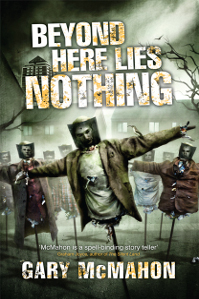
Beyond Here Lies Nothing by Gary McMahon


A few years ago, Gary McMahon mesmerized readers with an apocalyptic vision of an urban nightmare. The Concrete Grove (with its stand out artwork by Vincent Chong) came at a restless time when the real world seemed to hold up a sobering mirror to our own dark insecurities: not only in the author's native England, but for the collective world as a whole. With poverty, crime, and the decaying municipal jungle of The Grove as a playground, The Concrete Grove tapped into some of the things that truly scare us in the modern age. While the supernatural trappings were original (sinister hummingbirds are no trope), they seemed more of side dish to the main course: a human prison in the guise of a derelict suburb. Its sequel, Silent Voices, continued the tale in a more domesticated framework. With Beyond Here Lies Nothing, the author serves symmetry by taking his last book of the trilogy to the same lofty heights we experienced in The Concrete Grove.

This outing concerns another new character, Marc Price. Price comes back to The Grove to research a book about the ‘Northumberland Poltergeist' - an infamous case from the 1970s: twins haunted by the spirit Captain Clickety. Soon a relationship is underway with a local woman, the mother of one of the Gone Away Girls (children abducted years previous with no evidence of how they disappeared). That bygone case has also left an indelible mark on local cop Royle, a hardened man with an addiction to alcohol who seems to embody the Grove itself. 


Not far from The Needle, scarecrows appear, their heads plastered in photographs of the missing and the dead ... 


In this, the culmination of a story arc, Gary McMahon accomplishes what he set out to do: unsettle the reader not with supernatural overtures but with a desperate and broken people. If The Concrete Grove were a musical project, Beyond Here Lies Nothing would be its greatest hits compilation; a symphony of the damned returning to the Needle with unfinished business or an ultimate score to settle. Though scarred, they are well-rounded off-shoots, each player a component of the author's own black-garlanded psyche.

There were times here when I felt genuinely unnerved (rare for someone schooled in the genre). Dark and poetic, Gary is tapping into his own staple brand: a twisted school of thought we have only just glimpsed the surface of.  


Sunday, January 13, 2013

The Collector by Daniel I Russell


In the craft of writing, there are many things to love. One of them is that no matter when a story is composed during a writers career, it can always be taken from the fabled trunk, dusted off, and – with some diligent hard work - brought back into the present for a new audience. After carving out an enviable swath of horrific tales over the past few years, Daniel I. Russell has no doubt piqued more than enough interest over this time period for people to take notice – to wonder (perhaps in their own private musings), what other stories the author may have squirreled away. The Collector - Daniel’s second book – is one such tale ... a story Dark Continents have taken an interest in and (wisely) decided to give life to beyond the fabled trunk.

Penny Crescent has its share of flawed characters. There is the Harper house, home to Frank, his wife, and their two young children. With an unhealthy coffee addiction and a predilection for violence, Frank’s seething temper almost results in unemployment from his current position as a physics teacher. Across the road lives elderly Eleanor, a student of the occult. Her grandson Joe does not like her isolation, nor the street itself. But when he arrives in Penny Crescent on a mission of rescue, he soon finds leaving will not be an option for either of them.

And neither will it be an option for the malcontent Dean twins or their helpless mother. Reckless, the boys have made their shared cul-de-sac a personal playground, with no one immune from their criminal tirades or ruffian antics.

Not even Penny Crescents new arrival, The Collector.

He comes furtively at first, a tall stranger in a bowler hat. With red hair, a clipped accent, and the ability to read minds – The Collector soon gives up all pretence of kindly old scholar. The residents of Penny Crescent – ignorant of another world that lies just adjacent to them - have something he wants. And with a supernatural army at his disposal, the new stranger goes about the cat-and-mouse task of securing it.

The character of The Collector is by no means new. Down the corridors of speculative fiction we can see him manifest over the decades: Mr Dark from Something Wicked This Way Comes springs to mind ... also Leland Gaunt from Needful Things and Andre Linoge from Storm of the Century. Ancient, otherworldly – and with just the slightest trace of humour, they are the antagonists who passively sit in the background whilst Hell’s minions run rampant at their command. That isn't to say we don’t still find them endearing – we do. And Daniel makes sure this particular one has just the right balance of sophistication and malign intent.

With any novel this big, there will be drawbacks. And with The Collector I found it was something I hinted at earlier: time. Being only the author’s second book we can see a distinct flavour of simple, almost juvenile monsters running throughout the chapters. The story itself is like a bridge in Daniel’s reading habits; an amalgamation of Richard Laymon and Clive Barker, respectively. As a whole this can be sometimes be grating - because the styles do not suite as a working duality within the same book.


But there are also many strengths ... and that’s Daniel's trusted ability to simply to entertain. The dialogue is realistic, and the characters are abhorrent and likeable enough in equal measure. If I could compare this to another work that has a similar framework it would be The Regulators by Richard Bachman. In that book, worlds collide and the horrors of suburbia are made manifest through the dreams of very ordinary people. Here Daniel I. Russell is working a very similar motif, but in his own distinctive voice. With a sequel on the way, The Collector is a tale that will only get better.


Saturday, December 22, 2012

The Next Big Thing


A series of questions that has been doing the rounds lately: 


What is the working title of your next book?

The working title, and the one that I imagine will stick, is called DAVEY RIBBON.

Where did the idea of the book come from?

Years ago (I think this may have been as far back as 2006), my younger brother and I decided on a brainstorming session for a collaborative effort of dark fiction. We are both cut from similar creative cloth (he a talented illustrator), with myself applying a life-long fixation with the horror genre into the Australian horror community by writing for HorrorScope. It was a session that didn't last long ... but he provided me with a few illustrations that would eventually germinate into what would become DAVEY RIBBON. Mainly, this was my ambitious attempt to pay homage to the stories I grew up with featuring small town mythos. I had already pursued the world-building path with the broader arc of a story called OLEARIA. Now it was time to scale down the canvas - to use a modern American town and its populace as a cauldron on the cusp of Hell. The trick here was sculpting a worthy antagonist - creating a fiend that was almost child-like in its sense of manipulating human beings. 

What genre does your book fall under?

I think the story is probably too subtle for HORROR. Let’s just stick with dark fiction.

What actors would you choose to play the part in a movie rendition?

I wouldn’t want to give away the title character with an image... or any others for that matter. The beauty of the written word is that it creates a lens that is entirely at the discretion of the reader. If you had gone to see The Shining before actually reading the book, chances are you would see nobody else but Jack Nicholson’s face strutting around on those pages. For me, that’s utterly limiting.

That said, I could easily imagine Timothy Hutton playing Sean Hunt - and perhaps a younger Max Von Sydow playing Norman Perks. If she was at all interested I’d let Amy Lee of Evanescence play Samara Reagan.

What is the one sentence synopsis of your book?

The story of Davey Ribbon was told in reverential whispers.

Will your book be self-published or represented by an agency?

Although I’m a big advocate for self publishing, I think this one deserves to have a broader audience. So with that in mind I’ll be seeking a traditional publisher.

How long did it take you to write the first draft of the manuscript?

Although the story isn’t overly ambitious this was years in the making because I kept putting it aside for months at a time. It was only on the advice of someone very dear to me that I decided to go ahead and finish the story.

What other books would you compare this to with stories in your genre?

The initial seeds were probably planted with King’s Needful Things. But after that it has kind of morphed into more of a ghost story along the lines of the movie Darkness Falls.

Who or what inspired you to write this book?

No one thing, really. Just that it was time to try and dig something big out of the sand.

What else about the book might pique a reader’s interest?

For those people who have read and enjoyed my shorter works, this is Matthew Tait shifting gears and moving up a notch. Although a lot of the story here can be classified as homage, there is also a lot of recognizable heart from my own life - something that I try to instil in everything I write. It’s the old adage of simple revenge – but it also how myths and legends are told through reverential whispers ... and how they are manipulated over time to be given a form of life itself.

And one last thing ... if it had a soundtrack it would be something composed by Christopher Young.

Passing the baton onto Troy Barnes, Paul Mannering and Brad Hodges. 


Friday, November 30, 2012

Silent Voices by Gary McMahon


Returning to the realm previously envisioned in The Concrete Grove, UK author Gary McMahon creates, via Silent Voices, the second part of a now-trilogy. Although there are off-shoots of the previous tale here, this is a different kind of beast altogether. Whereas the first invited us into the bleak atmosphere of The Grove itself (like a hummingbird’s view of it), Silent Voices is more a character study of three individuals (Simon, Marty, and Brendan) who battled its demons as children and - years later and now grown into adulthood – return to the Grove for a final revelation, closure, or both.

The Good:

Steeping back into Gary’s narration is akin to a homecoming. The syntax – while a little less cerebral this time around – moves around the page like dark poetry. There is also an every-man eloquence to the mood: these are hard character's chiseled from austere upbringings: Simon Ridley is a successful entrepreneur, the only one to escape the Grove, but a man unhinged all the same. His friend Brendan suffers the same insecurities we all reach upon seceding into adulthood: keeping up a pretense of happiness when the dream machine of our youth has an ‘out of order’ sign attached. And Marty has all the hallmarks of what a neglected childhood can sometimes usher in: masochism and brutality to hide what lurks beneath. When the three reconcile to talk about a weekend in the Needle twenty years previous they cannot recall, the resultant outcome is a commanding story of sin and salvation.   

The Drawbacks: 

The second outing of a trilogy is never an easy one; the story usually a bridge to a final farewell that can be wobbly at the best of times. Somewhat formulaic, Gary has chosen the trope: best friends who battled an evil in childhood are summoned as adults to confront the monster again. For me, this is somewhat well-worn, and probably peaked during the eighties. There is a lot of story here where simply nothing happens, where plot-devices are pushed aside to make way for a character to brood inwardly and stare out of windows in drab reflection. The climax, when it comes, strives for the cinematic ... but with only one small flashback scene it can sometimes be hard to grasp the nostalgia and (horror movie) feel our author is trying to illicit.

Positives (and drawbacks) aside, this is still an accomplished work of dark fiction. It may not be McMahon firing on every cylinder, but even the author’s bridgework is head and shoulders above many others working in the same arena. The foundations of story have been set; the cement of the project has dried. The only thing left to do now is take one final journey back into the Concrete Grove ... and see what lies beyond it.  
 

Thursday, November 8, 2012

Red Town Lost by John Shupeck Jr.


Necro Publications continues its Fresh Flesh experiment with a debut novel from John Shupeck Jr. Here the author has woven four very different stories containing interlocking characters and situations. Like converging train lines ultimately intercepting at the same terminal, each story has the same analogous outcome. 

We begin in nowhere, Pennsylvania - and Dan Suppers is looking for civilization after breaking down in his car. Soon he stumbles upon the still-smoking and charred aftermath of a large fire, the remnants of an entire small town’s populace. With no survivors to tell the tale, Dan is left to piece together the mystery of Kecksgille’s final moments ... and how an entire municipality ended in a baptism of blood.

Incipientium:

Slow out of the gate, Incipientium chronicles a young Mike Rearick and his merry band of friends as they make their way to the local Kecksgille Baptist Church and a night of revelry. But the resultant climax here is more like a reverse-coin Children of the Corn that will see Kecksgille’s adults – guided by the hand of a local priest - rise up against the children in a well-choreographed genocide.

Hypochondriac:     

As implied by the title, mental illness takes centre stage in this first person narration. Composed in diary form, we are slowly introduced into the ailing world of young Carl Truitt and the doctors tasked with helping him. Our narrator’s voice is sly, crass, and contains just enough adolescent humour to please any underdog.

River Road:

Chronicles the story of Zachary Bennett who takes the path less traveled in an effort to escape an impoverished existence and parents battling addiction. A mere child when he begins his journey, Zachary Bennett comes to age almost overnight after being pitted against the ‘medicine man’ of his nightmares. A final showdown in heart of Kecksgille rounds off a story rooted in subtext.

Spider Arms:

Another tale of the underdog, Spider Arms centers on Kevin Ritchie, Kecksgille’s neighborhood teenage punching bag for Jocks everywhere. Cursed with a subtle malady that redefines lanky, Kevin decides – on one fateful day – to fight back. But not in the manner his adversaries expect. Ultimately a routine narrative of revenge.

There are a few other intervals here in Red Town Lost – some clever, others mystifying – while the syntax (at times) can be awkward and comes pre-packaged with run-off sentences and juvenile metaphysics. However, as a working whole there is a quality of strangeness that grows as the story progresses. If some of the plot devices are a little too deus ex machina for some readers, I suspect more light can be shed on them in John’s illuminating and candid afterward.

Red Town Lost is available now from Necro Publications.


Monday, October 15, 2012

A Gentle Hell by Autumn Christian


Another slice of stories as part of Dark Continents Tales of Darkness and Dismay series, A Gentle Hell by Autumn Christian showcases a distinctive cluster of four tales – brimming at the edge with what could be termed ‘surrealist’ fiction but devoid of absurdity. Often hard to nail down but somehow more potent for it, this is a body of work very similar to my previous review ... where the story is – at the discretion of the reader – always open to interpretation. The ultimate payoff here is keen insights from the author and elegiac prose.

An almost dystopian alternate reality is the scene for They Promised Dreamless Sleep. Here our narrator reports living in a realm where families consensually hook up to ‘machines’ and are placated in severe and disturbing ways. Shades of 1984 with a domestic twist.

In Your Demiurge is Dead we step into Neil Gaiman territory with the death of a God and the birth of another. Jehovah has washed up – dead – on the Gulf of Mexico. Heralding a new era for humanity is the Triple Goddess. Another domestic setting is instigated with a police investigation into deaths in a large family. Through quirky characters and idealistic insights, we are granted a story that is at once confounding yet absorbing. 

With the The Dog That Bit Her, Autumn delivers what is probably the most unique Werewolf tale you’ll ever encounter. It’s a story about psychological addictions and slavish trust – all given credence by a storyteller who witnesses his wife’s slow decent into what could be termed, unquestionably, a gentle hell.

It is the last tale, however, that is probably the hardest to grant revelation. In The Singing Grass, I imagine artists everywhere will be granted something within the prose to identify with as a writer tries to find her muse. Heavy on metaphor, and (in the end) gore, it somehow serves as symmetry and complements what has come before.

For many, this will be a difficult journey. The often rudimentary formula of ‘story’ has been abolished in favor of flights of fancy that are allegorical or dream like in nature. It is often claimed for horror that it draws on our primitive responses but, as in key moments of this collection, the best stories can owe their power to something closer to the modern surface.


Saturday, October 6, 2012

Valentines for the Dead by Corrine De Winter


The winner of a Bram Stoker award for poetry a few years back, Corrine De Winter is a name that has – up until now – escaped me. Following a quick perusal of past achievements we find a lyrical writer held in high regard by the collective tribe. In between reading some of the more commercial fare over the course of a year, I like to seek out those elusive gems: fiction not sliding easily into any well defined category. Valentines for the Dead - for all its intangible qualities - is an innovative collection that more than satisfies this requirement.

And make no mistake: this is indeed the territory of a poet. From the opening story Halo a reader is granted prose that shies away from the nuts and bolts of story, favoring instead a lyrical syntax told primarily in first person. Although the horror can be difficult to find at times, Corrine keeps it waiting in the wings – a small turn of phrase giving way to an unexpected twist where all that has come before can be questioned. Whether it’s a child who grows up in a house of thaumaturgy and eventually learns to fly (or a jealous sibling who dabbles in fratricide for eternal love), Corrine has a powerful command of language with just enough obscure story to perhaps warrant a second reading. If I could level a certain criticism, it would be that each first person tale contains a similar voice; with the run-off sometimes confusing. It was challenging, at times, to ascertain where old territory ended and new characters began.

A few personal standouts would include Youth is Wasted – a modern Frankenstein riff where a child pays the ultimate price for an elderly man’s broken heart. Watercolor is delightfully malign; a domestic Village of Damned that, in due course, brings forth new life from death. But taking out the top prize here would have to be Dead Boys – an original blend of fact and fiction centered on the subject of premature death in rock n’ roll's realm ... and the individuals who deal with our flesh after expiration.

A short story collection that is mythic, thought provoking (and with just the right twist of gothic), Valentines for the Dead is an accomplished fictional début from a unique talent.


Monday, October 1, 2012

ROPE by Martin Livings


When Stephen King first published The Green Mile in serial format back in 96, the story was my first large-scale exposure to death row in a fictional setting. Not just death row, but in particular the electric chair. Although I don’t know for sure, I’m betting there are reams of genre fiction encompassing this particular milieu: everything from stark legal thrillers in the mold of John Grisham, to frightening serial killer fodder, the tortuous playground of writers such as Thomas Harris and James Patterson. However it was King’s magical yet realist tale (for me, anyway) that finally pushed capital punishment screaming into a kind of cultural awareness. Upon finishing the book, I’m sure I’m not the only reader whose curiosity was suddenly piqued by the taboo of execution – not only the myriad methods involved, but also the untold stories of those behind the curtain: the men and women charged with dispensing unfeeling and clinical justice to the condemned.

Martin Livings has, no doubt, had similar thoughts.

Our tale is begun at the turn of last century, with Australia’s Fremantle prison struggling to pull itself out of a national convict past. A nameless narrator shares with us the humble beginnings of being a sanctioned serial killer: that of the hangman. An apprentice from a young age, he is given the responsibility of fashioning his own noose, a rite of passage, that will see him embrace his calling and ultimately being defined by it.

Life itself is a rope with a noose at each end, just like mine.

A short excursion, Martin manages to cram a lot of character study into a small space, and it’s personally how I like my paragraphs: weighty with exposition and lean on dialogue. In some ways Rope is partly reminiscent of The Green Mile, whereby story is ultimately foreshadowed by sin that leads to a different kind of redemption.

Martin Livings has been traversing Australia’s dark fiction scene for over two decades, providing dependable tales with a mature rendering of prose. Although brief, Rope still manages to deliver something that is unmistakably the author's.


Saturday, September 22, 2012

Edge by Koji Suzuki


A name now synonymous with dark fiction, Koji Suzuki rose to prominence as the original author of the Ring Cycle books, a sub-set of accomplished outings sparking off not only English translations, but a veritable trove of manga and movie adaptations giving rise to a kind of renaissance in Japanese horror fiction and cinema. Quick to catch fire overseas, this new-found genus soon found an audience across the Pacific with American director Gore Verbinski re-making the original Ringu for English audiences ... an interpretation that to this day remains all enduring with its tone and tension-wrought climax.  

It’s an impressive resume, but right off the bat I’m going to inform reader's EDGE is my first introduction to the authors prose – and partly why I decided to take on the book for appraisal. Here, Koji shifts gears in a largely new direction from what we have come to know in his thematic world of J-Horror: poltergeists given a wide birth in favour of terrors more existential in nature ... the fear of nature itself. In the past few decades, science (and in particular fields of study such as quantum mechanics), have offered us a glimpse of an unseen world lying just under the surface of our perceived senses. Through a universal language like mathematics, we are discovering this realm is not only more mysterious and complex than we ever imagined, it is ultimately spiritual in nature ... with consciousness itself playing a vast role capable of influencing the material world.

After the mysterious disappearance of her father in 1994, freelance reporter Saeko Kuriyama feels divorced from life. When unexplained phenomenon begin to take hold of Japan – namely individuals and families vanishing into thin air overnight – Saeko feels drawn to the mystery as though it could be her personal calling. Reminiscent of disappearances such as the ghost ship Mary Celeste in 1872, the vanishings begin to spread over the entire continent in what soon becomes a discernible pattern involving fault-lines. When drafted by a magazine editor to explore the vanishing of one Fujimura family, Saeko teams up with a local TV station and a psychic to investigate the case. Together they slowly peel back the layers of a genuine unknown to find something far more sinister than a motley crew of missing persons: an anomaly rooted in natural causes – a profound disturbance in being itself.  

For a novel originally composed in another language entirely, the translation here comes off clean. With only one typo apparent, Koji’s syntax is free-flowing and smooth. There are some metaphors just beg to be read out loud, and the overall structure of the writing is intelligent and heart-felt. I suppose one criticism I could level would be the distinct lack of action; there are a lot of scenes where characters (and in particular Seako) spend numerous passages merely ruminating about underlying philosophies, coming to final conclusions only guessed at but then given veracity merely by deduction. However, when dealing with the subject matter (that of quantum horror) it seems Koji has purposefully taken this path. EDGE, for all its wonky science, is a moody journey. When delving into the climax, a reader can almost hear a cinematic soundtrack at the heart of the story ... a sensation not unlike experiencing some of the finer aspects of Gore Verbinski’s The Ring.    

An ambitious novel to take on, I can see there will be a few disgruntled readers with the topic at hand, and the blurb attached to various websites and the novel itself is overly misleading with how the story pans out. Personally, however, the focus here is a theme I’ve always held a fascination for: ancient civilizations and the advanced world they left behind. Our known recorded history – the one that we were collectively taught – seems inherently flawed with new evidence coming to light seeming to raise more questions than answers. Through astute personal observations and modern physics, Koji tries to find the answer to those mysteries, and ultimately delivers a unique reading experience reflective of the current cultural climate.     


Saturday, August 25, 2012

Vaudeville by Greg Chapman


2012 has been a fruitful year for Australia’s Greg Chapman. After cementing himself as a kind of polymath writer and artist in the wake of his successful graphic novel collaboration Witch Hunts, Dark Prints Press has seen fit to publish Mr. Chapman’s Vaudeville as part of their new novella series – latching onto an already bourgeoning eBook market and giving new voice to a this timely and passionate author.

After the suicide of his father Dominic one year previous, young Anthony Moore returns to the mysterious woods on the outskirts of his home town Keaton where the baffling act took place – for closure, for revelation – for the off-chance that perhaps the forest will yield its secrets to the grieving family left behind. A doting father and a loyal husband to Anthony’s mother, Dominic’s decision on that fateful day left a wake of repercussions that not only scarred a family but left an entire town disconsolate. Keaton Woods, home to a history violence, does more than reveal its secrets to Anthony ... it exposes the malevolent spirits who dwell within the trees – a travelling troupe of performers caught between Hell itself and dying to give Anthony just one last performance.

Perhaps one the shortfalls of Greg’s first novella Torment was a subtle lack of metaphor within the composition – but here the author (much to my delight) piles it on thick. We can see the writer’s confidence emerging to create images that are vivid, asides that are incisive, and prose that is elegant. The greatest hook with Vaudeville is probably its cavalcade feel – that sense of carnival tied with innocence whose roots are to be found in tales like Bradbury’s Something Wicked This Way Comes. The caravan of ghosts (whose names I will not reveal), are entertaining and wily – providing just enough sense of mischief and malevolence to keep them scary. What we have in the end is almost a coming-of-age tale that leads to a conjuring of Black verses the White – embodying the theme of an ancient evil who feeds on the souls of the living to survive.